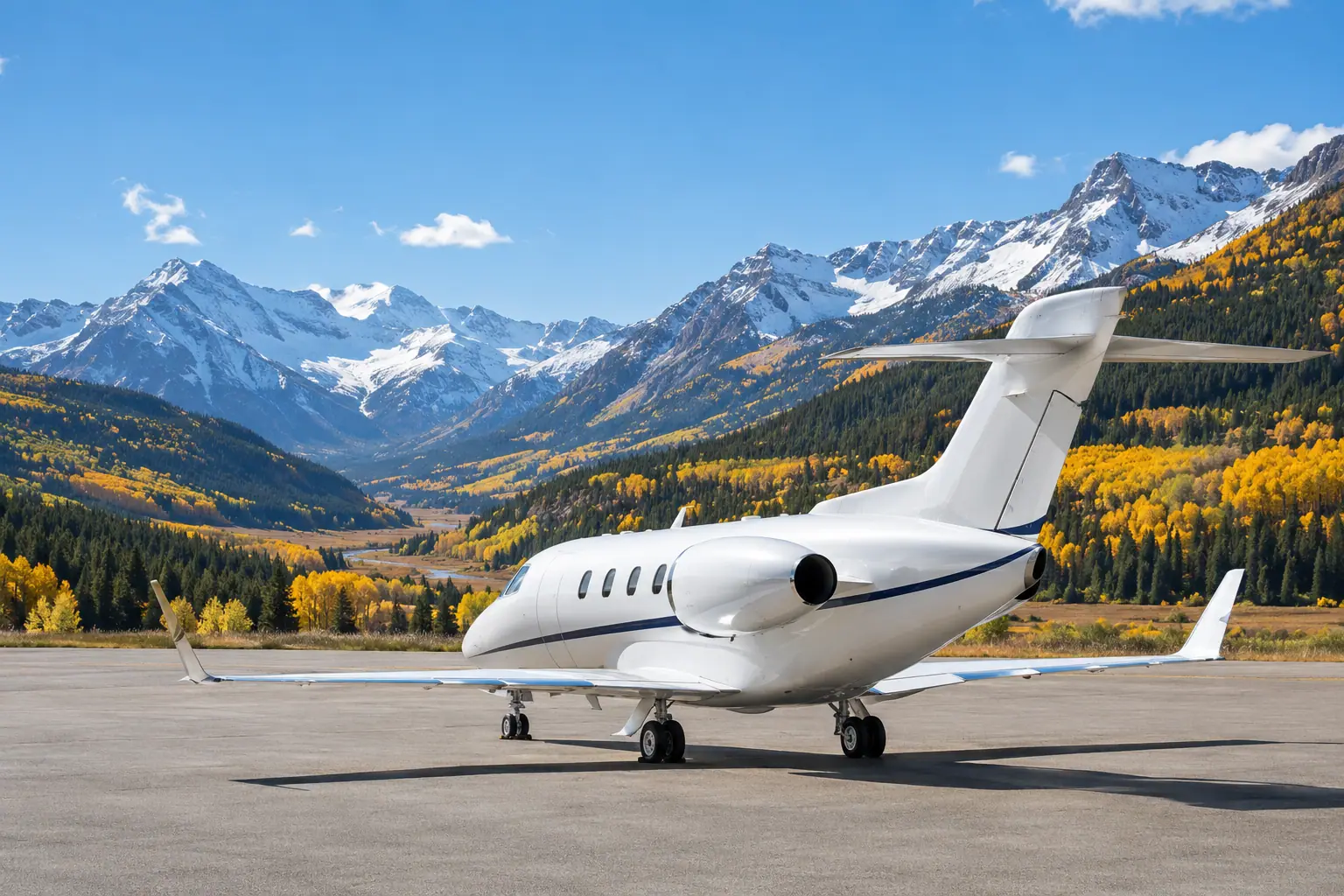
Empty leg flights Aspen
Empty leg flights Aspen travelers watch are one-way repositioning legs, not a standing schedule. A light jet on the 634 nm Los Angeles route normally prices at $7,000 to $10,500 each way. The discount exists because the aircraft must move anyway.
- Home
- Empty legs
What an empty leg into Aspen actually is
An empty leg is the repositioning segment an operator flies without revenue passengers, so empty leg flights Aspen compares are priced against the operator's cost of moving the aircraft anyway. When a midsize jet finishes a Palm Beach drop and must return to base near Aspen, that return leg can be sold below the standard one-way rate. The figure you see is a quote estimate, and it moves with fuel, crew duty time and how close the departure date is.
These legs are one-way by nature. A light jet that brings a family from Dallas to Aspen for the ski week usually has to fly home empty, and the empty leg flights Aspen sees most often run on the outbound side of a ski weekend. Schedules are not published in advance the way airline seats are, which is why travelers who can move on a few days' notice find the best matches.
How the quote process works
1. Tell us the window, not just the date.Give a range of two or three days. An empty leg exists because an aircraft has to be somewhere, so flexibility on the hour and the day is what creates a match.
2. We match you to live repositioning legs.We check current one-way segments against your route and aircraft class. A turboprop at $2,200 to $3,500 per hour and a heavy jet at $9,500 to $14,500 per hour are different markets, and the discount differs.
3. You get the operator and the terms in writing.Every flight is flown by an FAA Part 135 operator that holds operational control. We act as your agent under DOT Part 295, so the quote names the operator before you commit.
4. Book fast and confirm the airport.Empty legs are held on a first-confirmed basis. If the leg lands at Aspen-Pitkin County Airport (Sardy Field), confirm the FBO and the ground plan at the same time.
Aspen airport constraints on empty legs

Aspen-Pitkin County Airport sits at 7,820 ft with an 8,006 ft longest runway, and summer density altitude at Aspen can reach 11,000 ft, which limits which jets can depart with a full load. In July the density altitude figure is 11,000 ft, and at 115F it climbs to 11,600 ft. That is why some empty legs into Aspen are flown by aircraft that then reposition from a lower field, and why the return leg you see may not start at ASE.
The airport is 502 miles from the strip by road, so a diverted or repositioned leg has real ground consequences. Two FBOs serve the field, Signature Aviation - North and Atlantic Aviation. When a leg arrives on a peak Saturday, empty leg flights Aspen arrivals should confirm the FBO and the ground transfer before the aircraft is dispatched.
Who this works for and who it does not
Strong match
- Travelers with a two or three day window who can accept a departure time set by the operator.
- One-way trips where the aircraft is already repositioning, such as a return from a ski week or a holiday home.
- Small groups that fit the aircraft on offer, from a 5 seat light jet up to a 12 seat heavy jet.
A standard charter booking is the better option
- Anyone who needs a fixed date and hour, because an empty leg is a byproduct of another trip and cannot be scheduled.
- Groups larger than the cabin on offer, since the leg is tied to one specific aircraft.
- Travelers who need a guaranteed return, because the return is a separate charter at standard rates.
Questions
What are empty leg flights Aspen travelers can actually book?
They are one-way repositioning segments on aircraft that must move without passengers, offered at a discount to the standard one-way price. A light jet on the 634 nm Los Angeles route normally runs $7,000 to $10,500, so the saving is measured against that figure, not against a published fare. Availability changes daily and the quote is an estimate until the operator confirms.
How far ahead can I book an empty leg?
Usually a few days to a few weeks, because the leg only exists once the originating charter is confirmed. A turboprop repositioning at $2,200 to $3,500 per hour may appear with less notice than a heavy jet at $9,500 to $14,500 per hour. If your dates are firm, ask for a standard one-way charter instead.
Can I fly an empty leg out of Aspen rather than into it?
Yes, and outbound legs are common at the end of a ski week. An Aspen to Los Angeles leg covers 634 nm in about 1h 51m on a light jet, and an Aspen to New York leg covers 1,503 nm in about 4h 43m. The discount applies because the aircraft is returning to base regardless.
What does an empty leg cost compared with a normal charter?
The discount varies with the route and the notice, so there is no fixed percentage. Use the standard figures as your baseline: a light jet from Phoenix covers 417 nm in about 1h 19m at $5,000 to $7,500, while a heavy jet hourly rate runs $9,500 to $14,500. An empty leg is priced below the equivalent one-way on the same aircraft.
Does Aspen's altitude affect which empty legs can operate?
It does. The field elevation is 7,820 ft with an 8,006 ft runway, and July density altitude reaches 11,000 ft. At 115F it reaches 11,600 ft, which restricts payload on some aircraft. That is why an empty leg into Aspen may be flown by a type that departs from a lower field afterward.
Who operates the flight and who is responsible for it?
The flight is flown by an FAA Part 135 operator that holds operational control, including crew scheduling and dispatch. We arrange the trip as your agent under DOT Part 295 and do not own aircraft. For a leg crossing a border, CBP clearance applies, and TSA rules apply where the operator is enrolled in screening programs.